Many Australians live with a somewhat altruistic approach to life, a willingness to look out for the needs of others and lend a hand where possible. Perhaps, as suggested by the National Christian Life Survey, it stems from mateship – one of the National values we hold dear. Maybe it is a byproduct of living in a multicultural society in which people are generally aware from their own family circumstances, whether in this generation or previous generations, that struggle and sacrifice are embedded in the stories of many families, whether native to this land or those who have moved to Australia in search of a better life for their families. Whatever the reason, it is apparent that many of us (an above average amount, according to 2012 World Data estimates) want to help others where and when we can.
It is largely unsurprising, then, that so many Australians have heard the rhetoric about the proposed Indigenous Voice to Parliament and decided to vote ‘Yes’. Yes to creating a new, constitutionally enshrined Aboriginal and Torres Strait Islander Voice to Parliament, a body of Aboriginal and Torres Strait Islander people who are given special access to speak directly into parliamentary considerations on matters that affect their communities. Yes to getting grassroots information into the hands and minds of the makers of policy and the passers of new laws. Yes to, at least in theory, responding to the now longstanding request for our First Peoples to be seen, heard and have the truth of their history, including the terrible suffering inflicted upon their ancestors throughout the process of colonisation and on into the decades that followed, known and acknowledged in a more official way than ever before.
It has not been surprising over the last few days and weeks to see passionate support for the Voice bubble over in numerous ways. There have been long-winded, passionate social media posts from friends – some of whom have worked closely with Aboriginal and Torres Strait Islander communities. There have been short explainer videos expressing in brief the reasons for supporting the ‘Yes’ campaign. There have been unhelpful, slanderous barbs linking conservative Christians supporting a ‘no’ vote on this issue today to the actions of the people who forcibly removed children from Aboriginal and Torres Strait Islander families in the past. There have been, frankly, quite racist slurs levelled at Indigenous politicians from people pushing for a ‘Yes’ – labelling one female senator in particular a ‘coconut’ because her father has white skin, which apparently makes her opinion on Indigenous matters completely invalid (even according to other Indigenous people who are instead voting ‘Yes’ and have one Indigenous and one non-Indigenous parent, despite the obvious double standard).
There are so many voices, and for a long time the only voices I heard ringing out were those saying ‘Yes’. Certainly, as with many of these sorts of things, it feels the campaign in the affirmative that seems to try to pull at people’s heart strings has had far more airtime, though the dissenting voices, including from Aboriginal and Torres Strait Islander people who reject the idea of a constitutional voice to Parliament, have recently been making themselves heard.
The issues are known and have been broadcast in the media: truth telling, land ownership, sovereignty never being ceded, access to education, lower life expectancy and poorer health outcomes for our First Peoples, proportionally high numbers of Aboriginal and Torres Strait Islander people in our prison systems, the destructive effects of alcohol on communities… These are some of the key areas in which there have been systemic failures in recent decades, on top of many other failures since colonisation, of governments and leaders to adequately protect the wellbeing of Aboriginal and Torres Strait Islander people.
Some of these problems are practical. Some are ideological. I want to see better outcomes for our First Peoples, especially in the practical areas in which governments can effect real change. Problems like sovereignty never being ceded may be harder to address. The Uluṟu Statement from the Heart refers to Indigenous sovereignty as co-existing with the crown.
This sovereignty is spiritual notion: the ancestral tie between the land, or ‘mother nature’, and the Aboriginal and Torres Strait Islander peoples who were born therefrom, remain attached thereto, and must one day return thither to be united with our ancestors. This link is the basis of the ownership of the soil, or better, of sovereignty. It has never been ceded or extinguished, and co-exists with the sovereignty of the Crown.
How could it be otherwise? That peoples possessed a land for sixty millennia and this sacred link disappears from world history in merely the last two hundred years?
With substantive constitutional change and structural reform, we believe this ancient sovereignty can shine through as a fuller expression of Australia’s nationhood.
Excerpt: Uluṟu Statement from the Heart (2017)
Could this ever be recognised practically in a way that actually satisfies the deep desires of our First Peoples to govern themselves and their land while also living in a colonised Australia, without undermining the stability of the form of government that seeks to represent (albeit imperfectly) all Australians?
Again, to be clear, I would like to see problems that are impacting the wellbeing of our First Peoples addressed, particularly in areas in which governmental decisions have the power to enact some practical change, such as education, health, incarceration rates and problems relating to alcohol. I think almost all Australians want to ‘close the gap’ (unfortunately a potentially loaded political term, I know) to ensure all Australians can live together peacefully without systemic issues contributing to inter-generational crises for our First Peoples.
The question Australia faces then is, with our commitment to mateship and another core Aussie value, our shared desire for everyone to have a ‘fair go’, is the Voice to Parliament the best way to do go about addressing the issues facing Aboriginal and Torres Strait Islander people? Has it been well constructed? Is constitutional change going to flow through adequately to grassroots communities? Will this new body end up plagued with problems like the Aboriginal and Torres Strait Islander Commission (ATSIC), although the new Voice won’t be a body that controls funding. Can a Voice of 24 people actually speak to government for all Aboriginal and Torres Strait Islander people in a way that satisfies these communities? Is it even responsible of one generational period of Australians to enshrine in the constitution a representative body on behalf of one group within Australian society, which barring a future referendum to reverse becomes a permanent requirement for all future governments?
Wrestling through these issues, I was pleased to see an old friend of mine offer to answer any legal questions his friends may have on the Voice. He and I have not spent a lot of time together over the last decade and I know that some of our values now differ, but I reached out for his thoughts. One thing that particularly troubled me, and still does, is whether enshrining the Voice could set a legal precedent on which other sections of Australian society could base a claim to need a similar representation for themselves at a national, potentially policy shaping level. he agreed that it could, and this would need to be assessed “on merits if and when it happens”. As a Christian, my immediate question is by what standard would these merits be assessed? Sadly, I doubt the word of God, which should ultimately govern the lives and values of believers the world over, would be high on the list of assessment tools with which to weigh such a request for representation. Could it lead to unfair representation for groups wanting to gain a ‘leg up’ and could it further divide Australia on some key social issues? Some Indigenous leaders who don’t support the Voice have labelled it the Voice of Division, and when you take away the media rhetoric, it’s hard not to see where they’re coming from. Is singling out one group and giving them special privileges based on their ‘race’ actually a move forward or is it a move back in time? Surely none of us want to go back to pre-1962 when the Electoral Act had to be changed to allow Aboriginal and Torres Strait Islander people across Australia to contribute their voice in how we should be governed with the right to vote (Australian Institute of Aboriginal and Torres Strait Islander Studies (AIATSIS), 2022).
I was interested to find out that my friend mentioned above, for whom I have great respect despite some differences in our values and worldviews, said that “For me, reading the Uluru Statement and the referendum council report really crystallized my thinking; everything else is pretty much just politics.”
I took this as advice, and set about reading as much as I could. Here are some findings, which may or may not be helpful to others, but have helped me nonetheless to understand the context of this referendum far better than before.
The Uluru Statement from the Heart
This document is emotive. There’s no getting around that. It makes its case with heavy reliance on cultural, spiritual and generational ties to the land. It sounds like a unifying statement by our First Peoples, especially towards the end.
In 1967 we were counted, in 2017 we seek to be heard. We leave base camp and start our trek across this vast country. We invite you to walk with us in a movement of the Australian people for a better future.
Uluṟu Statement from the Heart (2017)
Indigenous leaders opposed to the Voice, however, have labelled this document as divisive, with one prominent leader saying it is marketing speak, a well-presented glossy set of words that lumps all Indigenous people together, enshrines segregation into our constitution by giving one group special powers over all others and perpetuates a victim mentality which he believes is unhelpful and destructive for the future of Aboriginal and Torres Strait Islander people living in modern Australia (Cross, 2023).
While I want to be understanding and show goodwill to the writers of the Uluṟu Statement, I’m left with the following questions about it:
- Why is it presented as a one-page document online, when in reality it is far longer (26 pages is the figure I’ve seen quoted, but in the Referendum Council Report I counted 16 pages of actual text from the statement)?
- Why is the content of the one-pager omitting important information about the diversity inherent within Aboriginal law – a factor which seems important when talking about how two groups can co-exist with some sort of co-sovereign arrangement?
- Why is the statement so hard to find? On its Uluṟu Statement website, an English speaking person has to scroll through a preamble, an overview of ‘The Voice at a glance’, reasons to support the Voice, what you’ll be voting on, opportunities to signup to a newsletter and buy merchandise or make donations, find a translation of the Voice in an Aboriginal or Torres Strait Islander language or read frequently asked questions. Only then, under the first heading in the website’s footer, can you click through to read the one-page version of the Uluṟu Statement from the Heart in English. It may not be that those presenting the statement are trying to hide anything, but it does seem, from an end user’s perspective, odd (to say the least) that the statement intrinsically tied to this referendum is buried as a tiny link in the footer of its own website.
- What is meant by the following excerpt: “we believe this ancient [Aboriginal and Torres Strait Islander] sovereignty can shine through as a fuller expression of Australia’s nationhood” (Uluṟu Statement from the Heart (2017))? The idea of co-existing sovereignty seems like a nice ideal, but also inherently oxymoronic. When two sovereignties try to co-exist in the same space, it seems another higher sovereignty would need to be the arbiter of the two lesser sovereignties, to prevent friction or even conflict when the two sovereignties disagree. From a Christian worldview this makes sense – and could, in theory, work in a government sense, providing both co-sovereign parties were willing to submit to a higher sovereignty – as God’s sovereignty trumps that of any earthly power. In a secular worldly governmental sense though, co-sovereignty seems quite implausible in the long term, especially as there is no independent Aboriginal and Torres Strait Islander government and there were over 250 ‘nations’ occupying the Australian continent prior to colonisation (Amnesty Australia, 2019).
- Finally, can an assembled group take the input from consultation with 1,200 people at 12 Regional Dialogues and actually represent over 800,000 people (Australian Beureu of Statistics, 2022) in a meaningful way that is agreeable and beneficial to all?
The Referendum Council Report
There is much that could be said about this 183-page report. Here are some thoughts.
- It seems this quote from the Introduction is very helpful: “The words ‘settlement’ and ‘invasion’ are highly charged for both sides of this historic encounter, but there is no use denying these two perspectives. It is understandable why some Australians speak of settlement, and why some speak of invasion. The maturation of Australia will be marked by our ability to understand both perspectives.” (Final Report of the Referendum Council, p.1)
- The opening letter says Indigenous Australians will find acceptable an Indigenous Voice to Parliament and an extra-constitutional recognition – this extra-constitutional Declaration of Recognition has not received much focus during the campaign around this referendum, but as the ‘devil is in the details’ and the biggest critique of the Voice campaign has been that too many details are as yet undetermined, it does raise a question as to whether there are other things outside of this referendum that will be required to truly satisfy the demands of the Regional Dialogues. The following requirement seems troubling on this matter, especially given what has already been mentioned about achieving unifying consensus for large groups of people; the second thing the report is calling for is “That an extra-constitutional Declaration of Recognition be enacted by legislation passed by all Australian Parliaments, ideally on the same day, to articulate a symbolic statement of recognition to unify Australians.” (Final Report of the Referendum Council, p.2)
- The report makes it clear that two key matters were considered as alternatives by the council: Section 116A, an anti-discrimination provision that is fairly general in nature, and the new Voice to Parliament.
- Interestingly, in regard to Section 116A, the report stated “The 116A proposal was explicitly supported in seven of the [12] First Nations Regional Dialogues whereas the Voice to Parliament was supported in all of them.”
- Of concern to me was the fact that the table on page 15 under the heading of ‘Outcomes’ shows responses to various reform proposals; the prohibition on racial discrimination was endorsed at a majority of the Regional Dialogues (7 of 12) and rather than being ‘not endorsed’ or ‘inconclusive’, the remaining five were ‘not recorded’, which makes one wonder about the transparency of these deliberations and whether the recording of the remaining five might have brought the result into line with the Voice option.
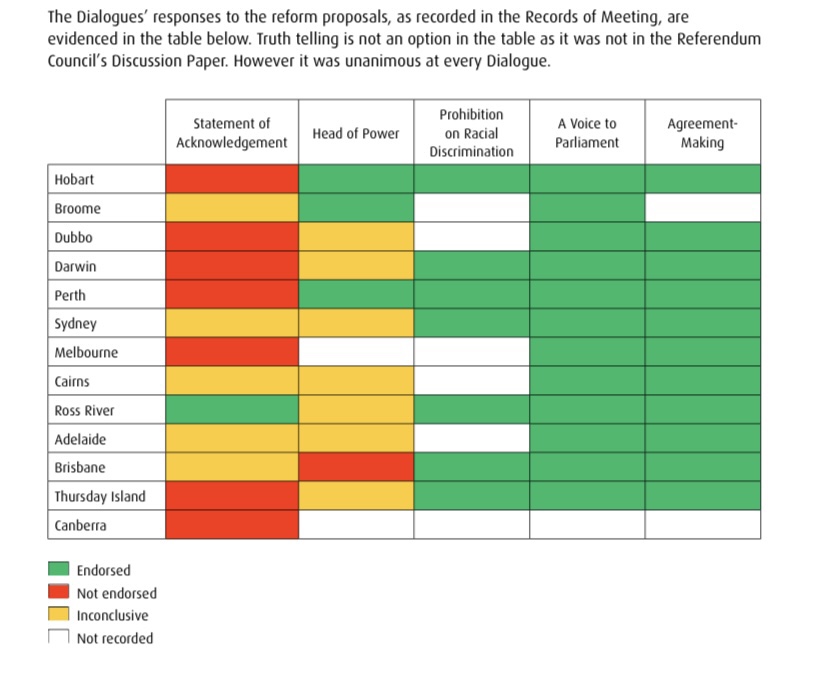
- The paragraph I found most concerning in the report flowed on from the mention of these two options and is quoted below in full:
Delegates to the First Nations Regional Dialogues were conscious that these two substantive proposals [Section 116A and the Voice to Parliament] were options, each being an alternative to the other. The protection against adverse discrimination provided by section 116A was viewed as a shield dependent upon interpretation by the High Court
Final Report of the Referendum Council, p. 13 (2017)
of Australia, whereas a Voice to the Parliament was viewed as a sword, enabling First Peoples to advocate directly to the Parliament.
This is troubling because the primary role of governments is to restrain evil. This is true from a biblical worldview, but is also outlined in other writings, including Thomas Paine’s Common Sense, a revolutionary pamphlet from a proponent of American independence from Britain (Paine, 1776). Modern democratic governments have other roles too, including caring for and supporting the vulnerable, which is largely necessary at government level because we as people have not done well enough at caring for one another voluntarily, but their primary role is certainly to keep the peace, not to wield a sword, or hand a sword to certain groups within society. Yes, crimes must be punished to keep society in order and threats to the peace must be thwarted by government intervention, but a government allowing one group of people to wield any kind of sword, political or otherwise, against other people based on race is, for obvious reasons, a terrible idea. To enshrine such a ‘sword’ in the constitution is to create an ongoing instrument, for this and future generations, that contains an inherent degree of ideological and potentially practical force, animosity, division and destructive power.
I say this as someone who does want to see better outcomes for Aboriginal and Torres Strait Islander people in many areas, but also as someone struggling to see – based on the Uluṟu Statement from the Heart and the Final Report of the Referendum Council – that the Voice to Parliament is the best way to go about achieving this goal, for the benefit of all Australians.
There are many other points that could be made, but it seems pertinent to point out that a big part of the push for the Voice has been based on the claim that Aboriginal and Torres Strait Islander people currently are not well represented politically. This, however, is not due to not having a system that can give them a voice, but flaws in the system we have, which should be rectified. Elected Members of Parliament are elected to represent the people in their electorate, whether Indigenous to Australia or not. If Aboriginal and Torres Strait Islander voices are not being heard by Members of Parliament, the responsibility lies with those Members of Parliament to ensure they are adequately and accurately representing all of their constituents. Introducing a new system to enable more representation to Members of Parliament from that group is like a band aid solution to a bigger problem. I heard a report this week about the current government ignoring advice from Aboriginal leaders. Since the Voice would be an advisory group only, there is nothing to ensure this advice, which in this case was already being given by grassroots communities, will not continue to be ignored.
Ultimately, I don’t know all the answers. No one does, but the Voice seems like an answer with two many associated unanswered questions. No doubt many Australians will vote (or have already voted) yes today to enshrining in our constitution an Indigenous Voice to Parliament, but I wonder how many would still vote yes knowing it was seen as a sword by those whom it is meant to serve.
Ultimately, whatever the outcome of this referendum, I look forward to the day when all people, Indigenous and non-Indigenous Australians, Christians and non-Christians, people from every tribe and tongue and nation, will have to acknowledge the sovereignty of the God who created this land on which we live, and the earth as a whole. His is the sovereignty that will matter for eternity. May more people of all backgrounds come to know and love the Sovereign One to whom all earthly governments are subject in the months and years ahead, and may we allow His priorities to shape ours as we make decisions about our earthly futures, knowing it is all held in His all-powerful hands.
Now therefore, O kings, be wise;
Psalm 2:10-11 (ESV)
be warned, O rulers of the earth.
Serve the LORD with fear,
and rejoice with trembling.
Remember this and stand firm,
Isaiah 46:9-13 (ESV)
recall it to mind, you transgressors,
remember the former things of old;
for I am God, and there is no other;
I am God, and there is none like me,
declaring the end from the beginning
and from ancient times things not yet done,
saying, My counsel shall stand,
and I will accomplish all my purpose,’
calling a bird of prey from the east,
the man of my counsel from a far country.
I have spoken, and I will bring it to pass;
I have purposed, and I will do it.
“Listen to me, you stubborn of heart,
you who are far from righteousness:
I bring near my righteousness; it is not far off,
and my salvation will not delay;
I will put salvation in Zion,
for Israel my glory.”
References
How altruistic are Australians? – NCLS Research (2023). https://www.ncls.org.au/articles/how-altruistic-are-australians/.
Country-level estimates of altruism (2018). https://ourworldindata.org/grapher/cross-country-variation-in-altruism.
First Nations National Constitutional Convention & Central Land Council (Australia), issuing body. 2017, Uluru : statement from the heart Central Land Council Library, [Alice Springs, Northern Territory] viewed 14 October 2023 http://nla.gov.au/nla.obj-484035616
Australian Institute of Aboriginal and Torres Strait Islander Studies (2022). The right to vote. [online] aiatsis.gov.au. Available at: https://aiatsis.gov.au/explore/right-vote#toc-voting-rights-for-all.
Cross, J. (2023) Warren Mundine calls Uluru statement ‘declaration of war’ in anti-voice press club address, National Indigenous Times. Available at: https://nit.com.au/26-09-2023/7832/warren-mundine-calls-uluru-statement-declaration-of-war-in-anti-voice-press-club-address (Accessed: 14 October 2023).
Eight facts about Indigenous people in Australia (2019). https://www.amnesty.org.au/eight-facts-about-indigenous-people-in-australia/.
Australia: Aboriginal and Torres Strait Islander population summary (2022). https://www.abs.gov.au/articles/australia-aboriginal-and-torres-strait-islander-population-summary.
Final report of the Referendum Council | Referendum Council (2017). https://www.referendumcouncil.org.au/final-report.html.
Paine, T. ‘Common Sense’. [online] Available at: https://americainclass.org/wp-content/uploads/2023/08/Common-Sense-Full-Text.pdf.

 Reformed Bapticostal